~/blog/rotation-invariant-phase-only-correlation-in-python.md
Rotation-Invariant Phase-Only Correlation in Python
I previously wrote an article called Phase-Only Correlation in Python, and this post is a follow-up.
With ordinary phase-only correlation, you can estimate image translation in the X and Y directions. In real applications, though, you often want to estimate rotation and scale as well. One approach for that is Rotation-Invariant Phase-Only Correlation (RIPOC), so I implemented it this time.
The procedure is roughly as follows. The key idea is to use a log-polar transform to convert rotation and scale into positional shifts in the image plane.
- Estimate rotation and scale.
- Apply FFT to each input image.
- Apply a log-polar transform to the FFT magnitude images so that rotation and scale become
XandYshifts. - Use phase-only correlation to estimate those shifts.
- Convert the estimated shifts into a rotation angle and scale factor.
- Generate an image with the estimated rotation and scale removed.
- Apply phase-only correlation again to the corrected image to estimate the remaining
XandYtranslation.
Log-polar transform
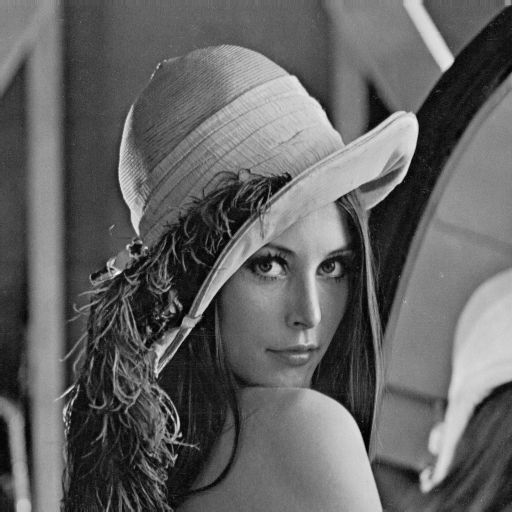
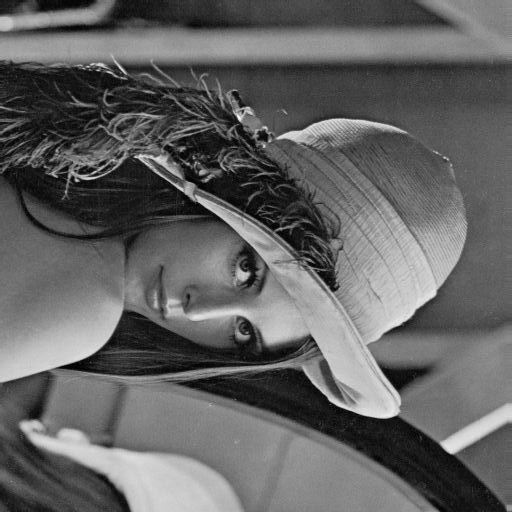
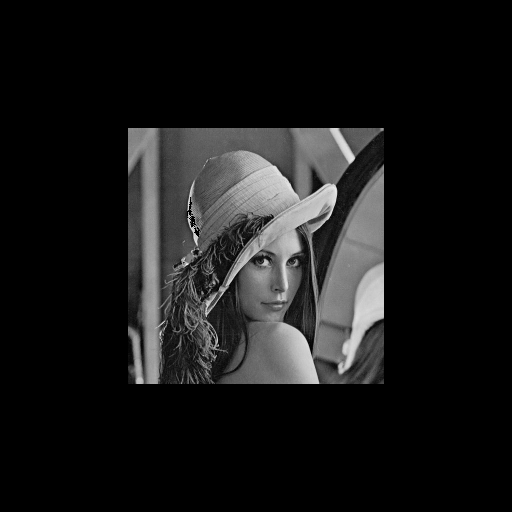
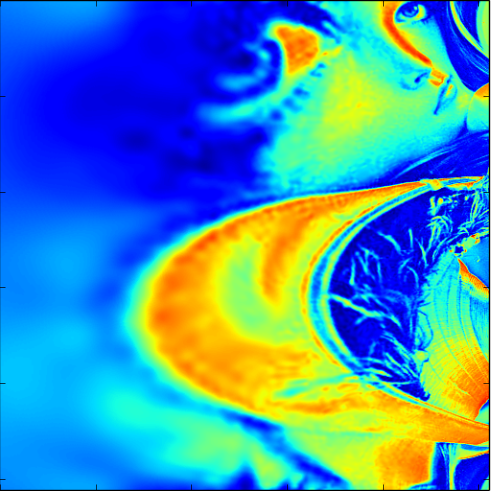
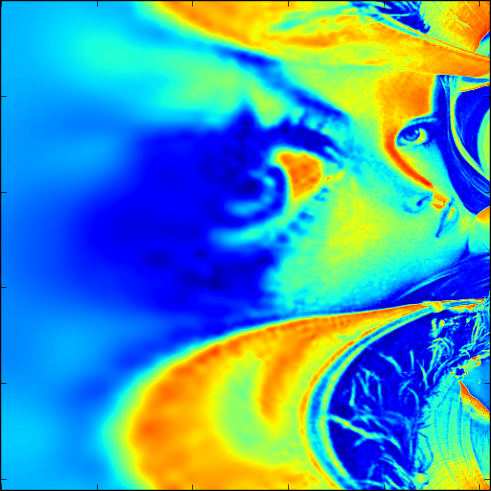
Below are the log-polar transforms of several images. If you compare them, you can see that rotation becomes a shift in the Y direction and scale changes become a shift in the X direction. RIPOC makes good use of that property.
 |
 |
 |
 |
 |
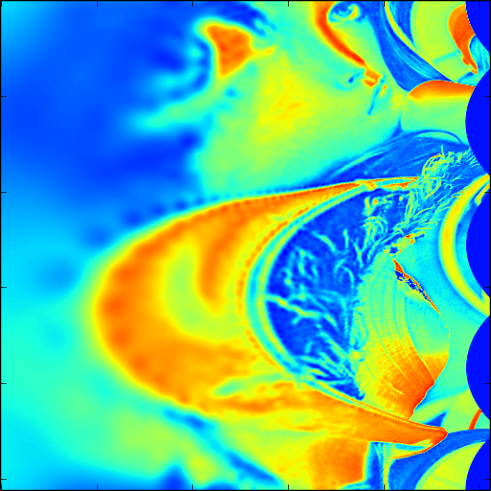 |
These images were generated with the logpolar function shown below using magnitude_scale = 100. This parameter has a fairly large effect on the accuracy.
Python implementation of RIPOC
Here is the Python implementation. There was not much reference material available, so there are parts I am not fully confident about. Depending on the amount of rotation, the scale change, and the log-polar parameters, the result can occasionally become unstable. Still, I am posting it here.
#!/usr/bin/env python
# -*- coding: utf-8 -*-
import sys

import numpy
from numpy import pi, sin, cos
from scipy.optimize import leastsq
import scipy, scipy.fftpack

import cv2
import cv2.cv as cv

import matplotlib.pyplot as plt

def logpolar(src, center, magnitude_scale = 40):

    mat1 = cv.fromarray(numpy.float64(src))
    mat2 = cv.CreateMat(src.shape[0], src.shape[1], mat1.type)

    cv.LogPolar(mat1, mat2, center, magnitude_scale, \
                cv.CV_INTER_CUBIC+cv.CV_WARP_FILL_OUTLIERS)

    return numpy.asarray(mat2)

def zero_padding(src, dstshape, pos = (0, 0)):
    y, x = pos
    dst = numpy.zeros(dstshape)
    dst[y:src.shape[0] + y, x:src.shape[1] + x] = src
    return dst

def pocfunc_model(alpha, delta1, delta2, r, u):
    N1, N2 = r.shape
    V1, V2 = map(lambda x: 2 * x + 1, u)
    return lambda n1, n2: alpha / (N1 * N2) * sin((n1 + delta1) * V1 / N1 * pi) * sin((n2 + delta2) * V2 / N2 * pi)\
                                            / (sin((n1 + delta1) * pi / N1) * sin((n2 + delta2) * pi / N2))

def pocfunc(f, g, windowfunc = numpy.hanning, withlpf = False):
    m = numpy.floor(map(lambda x: x / 2.0, f.shape))
    u = map(lambda x: x / 2.0, m)

    # hanning window
    hy = windowfunc(f.shape[0])
    hx = windowfunc(f.shape[1])
    hw = hy.reshape(hy.shape[0], 1) * hx
    f = f * hw
    g = g * hw

    # compute 2d fft
    F = scipy.fftpack.fft2(f)
    G = scipy.fftpack.fft2(g)
    G_ = numpy.conj(G)
    R = F * G_ / numpy.abs(F * G_)

    if withlpf == True:
        R = scipy.fftpack.fftshift(R)
        lpf = numpy.ones(map(lambda x: x + 1.0, m))
        lpf = zero_padding(lpf, f.shape, u)
        R = R * lpf
        R = scipy.fftpack.fftshift(R)

    return scipy.fftpack.fftshift(numpy.real(scipy.fftpack.ifft2(R)))

def poc(f, g, fitting_shape = (9, 9)):
    # compute phase-only correlation
    center = map(lambda x: x / 2.0, f.shape)
    m = numpy.floor(map(lambda x: x / 2.0, f.shape))
    u = map(lambda x: x / 2.0, m)

    r = pocfunc(f, g)

    # least-square fitting
    max_pos = numpy.argmax(r)
    peak = (max_pos / f.shape[1], max_pos % f.shape[1])
    max_peak = r[peak[0], peak[1]]

    mf = numpy.floor(map(lambda x: x / 2.0, fitting_shape))
    fitting_area = r[peak[0] - mf[0] : peak[0] + mf[0] + 1,\
                     peak[1] - mf[1] : peak[1] + mf[1] + 1]

    p0 = [0.5, -(peak[0] - m[0]) - 0.02, -(peak[1] - m[1]) - 0.02]
    y, x = numpy.mgrid[-mf[0]:mf[0] + 1, -mf[1]:mf[1] + 1]
    y = y + peak[0] - m[0]
    x = x + peak[1] - m[1]
    errorfunction = lambda p: numpy.ravel(pocfunc_model(p[0], p[1], p[2], r, u)(y, x) - fitting_area)
    plsq = leastsq(errorfunction, p0)
    return (plsq[0][0], plsq[0][1], plsq[0][2])

def ripoc(f, g, M = 50, fitting_shape = (9, 9)):

    hy = numpy.hanning(f.shape[0])
    hx = numpy.hanning(f.shape[1])
    hw = hy.reshape(hy.shape[0], 1) * hx

    ff = f * hw
    gg = g * hw

    F = scipy.fftpack.fft2(ff)
    G = scipy.fftpack.fft2(gg)

    F = scipy.fftpack.fftshift(numpy.log(numpy.abs(F)))
    G = scipy.fftpack.fftshift(numpy.log(numpy.abs(G)))

    FLP = logpolar(F, (F.shape[0] / 2, F.shape[1] / 2), M)
    GLP = logpolar(G, (G.shape[0] / 2, G.shape[1] / 2), M)

    R = poc(FLP, GLP)

    angle = -R[1] / F.shape[0] * 360
    scale = 1.0 - R[2] / 100

    center = tuple(numpy.array(g.shape) / 2)
    rot = cv2.getRotationMatrix2D(center, -angle, 1.0 + (1.0 - scale))

    g_dash = cv2.warpAffine(g, rot, (g.shape[1], g.shape[0]), flags=cv2.INTER_LANCZOS4)

    t = poc(f, g_dash)

    return (t[1], t[2], angle, scale)
Simulation
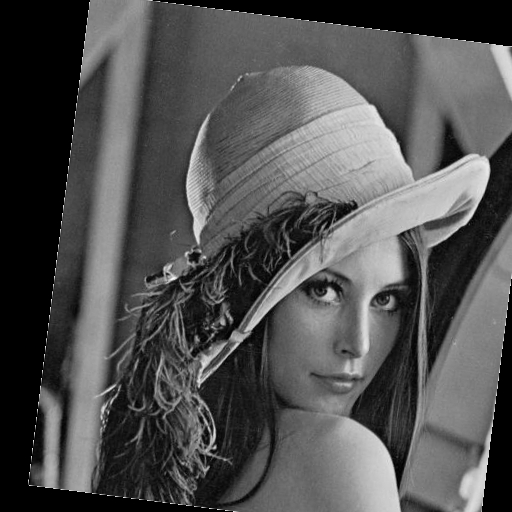
I applied RIPOC to an image created by shifting the original image by 59 pixels in X, 16 pixels in Y, and rotating it by 7.27 degrees. The result below shows that the displacement is estimated with high accuracy.
|
 |
from poc import *
img1 = cv2.imread("lena.jpg", 0)
img2 = cv2.imread("lena_x59_y16_7.27deg.jpg", 0)
ripoc(img1, img2)

(16.067704913163475,
 58.934512695463397,
 -7.2454451758682392,
 0.99979604899848151)
I also uploaded the code to GitHub: daisukekobayashi/pocpy